
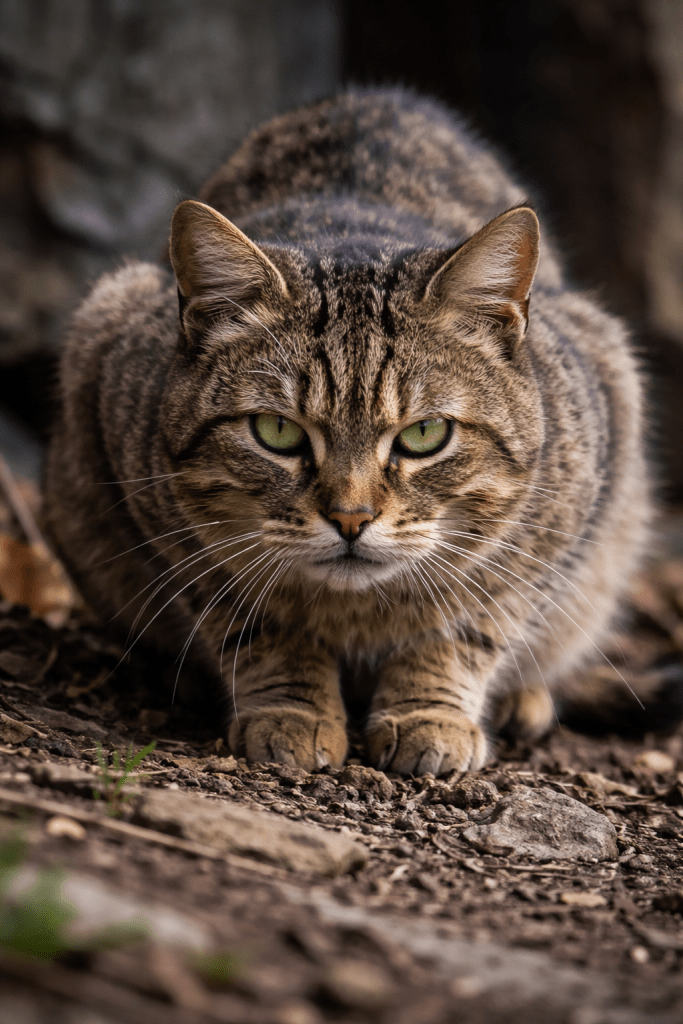
Many people see a cat outdoors and assume it is either lost, abandoned, or simply wandering around for fun. In reality, some outdoor cats are something very different. They are “feral” cats. Understanding what makes a cat feral can help people respond with more care, better judgment, and more realistic expectations.
A feral cat is not the same as a stray cat. A stray cat usually had some level of human contact at some point in its life. It may have lived in a home, depended on people for food, or once enjoyed being petted and handled. A feral cat, on the other hand, is a cat that has had little to no positive human contact, especially during the important early weeks of its life. Because of this, a feral cat usually sees people as a threat rather than a source of comfort.
The biggest thing that makes a cat feral is lack of socialization. Kittens learn very early whether humans are safe. If they are gently handled, spoken to, fed, and cared for by people while very young, they often grow into cats that can live comfortably around humans. If they grow up outdoors with little or no human interaction, they learn to survive on their own. They become cautious, defensive, and highly alert. Over time, that survival behavior becomes their normal way of living.
Feral cats are often born to other feral cats in colonies. A colony is a group of cats living together in an outdoor area where food and shelter may be available. (Such as under my deck) These cats may live near dumpsters, barns, alleys, abandoned buildings, or neighborhoods where people leave out food. Or in our case, bird feeders. Kittens born in these places often copy the behavior of the adult cats around them. If the adult cats run from people, hide from noise, and avoid being touched, the kittens usually learn to do the same.
Behavior is another important sign of what makes a cat feral. Feral cats usually avoid eye contact, keep their distance, and run away if approached. They may hide during the day and come out more at night when things are quieter. Unlike friendly house cats, they usually do not meow at people, rub against legs, or ask for attention. If cornered, they may hiss, spit, growl, or lash out because they are frightened.
It is important to remember that feral does not mean bad. A feral cat is not mean by nature. It is simply acting the way it has learned to survive. These cats live tough lives and often face hunger, weather, disease, injury, and danger from other animals or traffic.
The best way to help feral cats is often through trap-neuter-return programs, offered by some cities or counties, which reduce breeding and help colonies stay healthier. Understanding what makes a cat feral is the first step toward treating these animals with compassion and respect.
 catmando.blog
Leave a comment